Room Acoustics 101: How Your Room Shapes What You Hear
Your room is arguably the most important component in your audio system. Understanding how sound behaves in enclosed spaces is the first step toward better listening.

Callens Audio Labs
Ask me anything
Hi! How can I help?
Ask about our speakers, services, demos, or anything else.
Powered by AI · May make mistakes · Paul is always available
Most speakers spray bass in every direction, letting the room dictate what you hear. Cardioid bass changes everything - here's how it works and why it's a breakthrough for real-world listening rooms.

There's a fundamental problem with nearly every loudspeaker ever made, and it happens at the frequency range we feel most viscerally: bass. Below a few hundred hertz, conventional speakers radiate sound in every direction - forward, backward, sideways, up, and down - like an acoustic light bulb. The room then takes that omnidirectional energy and shapes it according to its own dimensions, surfaces, and furnishings. What you end up hearing isn't just your speakers. It's your speakers multiplied by your room.
Cardioid bass is one of the most significant advances in loudspeaker design in decades, and it attacks this problem at its source. Instead of trying to fix room interaction after the fact, it prevents it from happening in the first place. Let's unpack how it works, why it matters, and what it means for anyone who listens to music at home.
Sound radiation is directional at high frequencies and omnidirectional at low frequencies. A tweeter with a small diaphragm can be quite directional - its radiation narrows naturally as frequency rises. But a woofer producing a 50 Hz tone (wavelength: nearly 7 metres) radiates in all directions, because the wavelength is so much larger than the driver itself.
In a room, this omnidirectional radiation is a recipe for trouble. The bass doesn't just travel to your ears - it also hits the rear wall, side walls, floor, and ceiling. These reflections create standing waves (room modes) at frequencies determined by the room's dimensions. At certain spots the reflections add together, creating boomy peaks. At others they cancel, creating dead zones. Move your listening chair half a metre and the bass response can change completely.
This is why two people can own the same speakers and have completely different experiences. The room is doing as much work as the drivers - and unlike a carefully engineered speaker, rooms aren't designed for accurate sound reproduction.
A cardioid pattern is a heart-shaped radiation pattern (from the Greek kardia, meaning heart). If you've ever used a vocal microphone on stage, it was almost certainly cardioid - picking up sound from the front while rejecting it from behind. The same principle can be applied in reverse to loudspeakers: instead of picking up sound directionally, a speaker can emit sound directionally.
A cardioid speaker sends most of its energy forward, toward the listener, while dramatically reducing the energy radiated backward toward the wall behind it. Think of it as replacing the acoustic light bulb with an acoustic spotlight. The direct sound reaching your ears remains full and powerful, but the reflected energy bouncing around the room is cut substantially.
Making low frequencies directional is not trivial - wavelengths are too large for conventional horn-loading or waveguide techniques. The 8c uses an elegant acoustic solution from 100 Hz upward: it turns the midrange driver's back-wave into a cancellation mechanism. Below 100 Hz, the 8c uses a different technique - Boundary Coupled Bass - which we'll cover next.
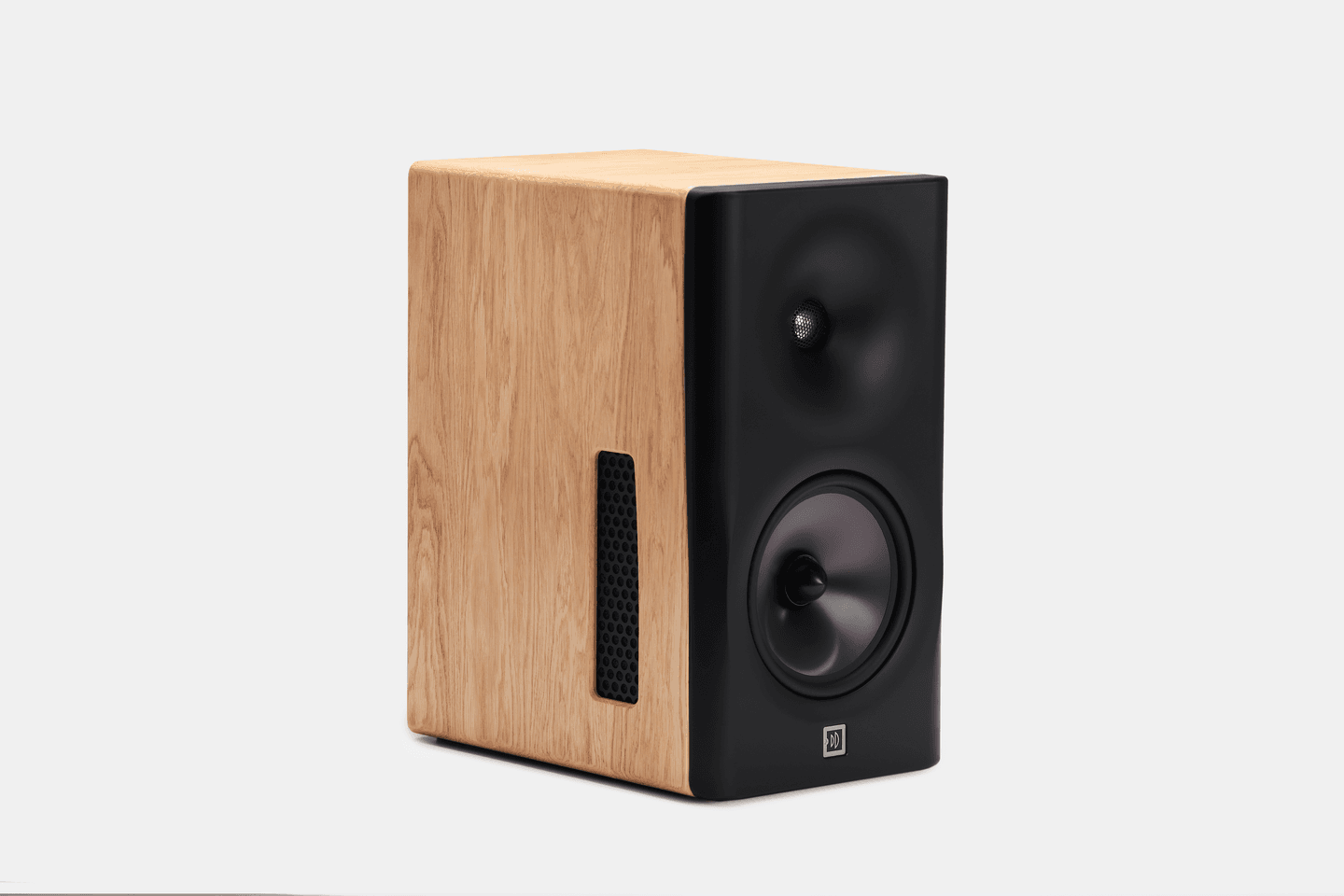
In a sealed-box speaker, the woofer's rear radiation is trapped inside the cabinet. In a ported design, it's channelled through a reflex port to boost output. The 8c does something different entirely. A single rear-facing midrange driver's back-wave is carefully channelled through tuned vents on the sides of the cabinet. By the time this back-wave emerges, it's out of phase with the forward radiation - and the two cancel each other at the rear of the speaker.
The result is a midrange that radiates in a cardioid pattern from approximately 100 Hz up through the crossover to the tweeter. The sound going forward is unaffected; the sound going backward is actively suppressed. No extra drivers, no complex digital processing - just physics, thoughtfully applied.
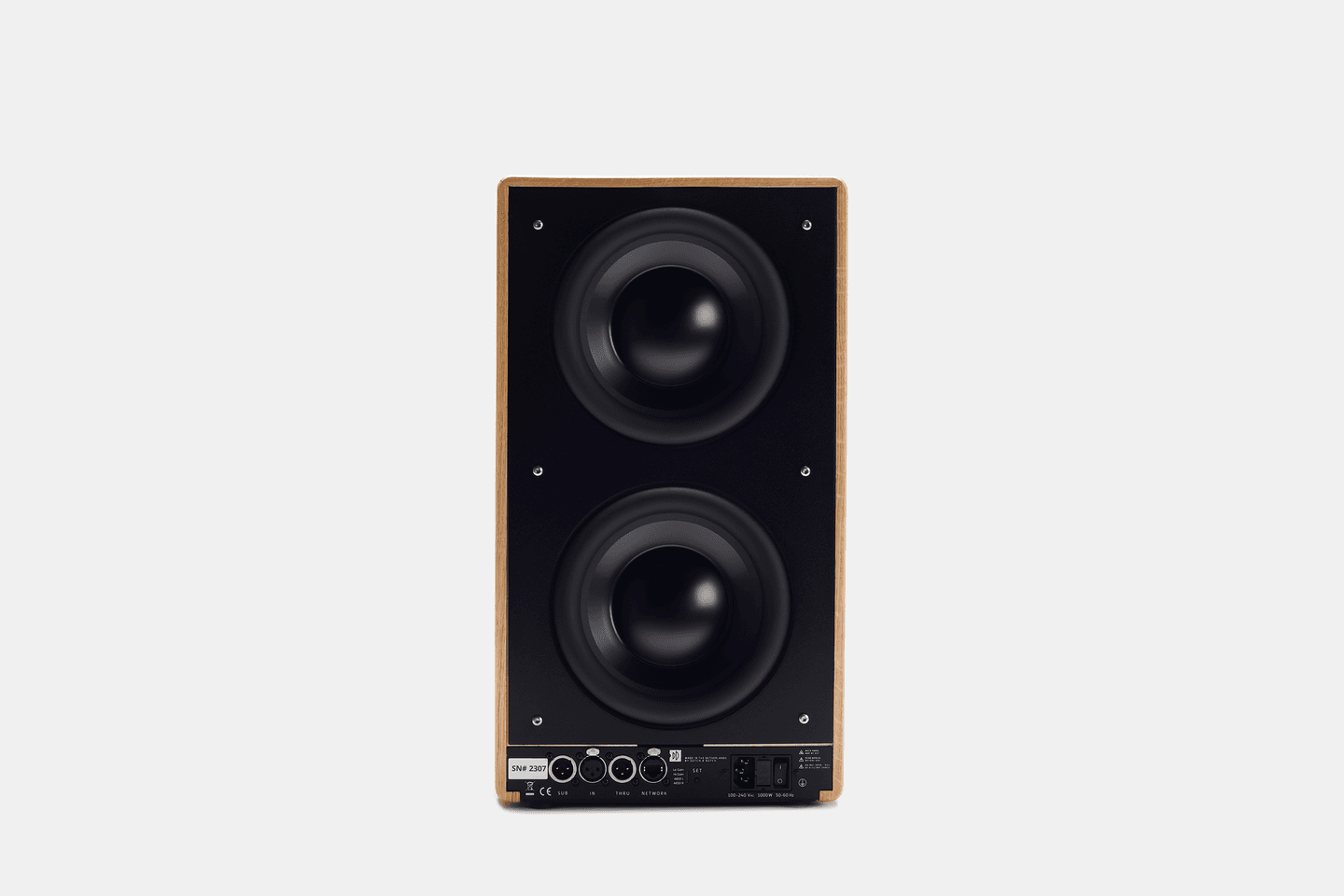
Below 100 Hz, the 8c takes a different but equally innovative approach. Two high-excursion woofers are mounted on the rear of the cabinet, firing directly at the wall behind the speaker. This isn't a mistake or a compromise - it's the entire point.
The design is called Boundary Coupled Bass (BCB), and it's built on research pioneered by the American loudspeaker designer Roy Allison in the 1970s. Allison's insight was elegant: instead of fighting the room boundaries, use them. When a woofer is placed close to a wall, the wall becomes an acoustic extension of the speaker - the woofer and wall form a coupled system that radiates in a controlled hemispherical pattern into the room.
“The influence of nearby room boundaries on loudspeaker output is not a defect to be minimised but a phenomenon to be exploited.”
- Roy Allison, 'The Influence of Room Boundaries on Loudspeaker Power Output' (1974)
Conventional wisdom says keep speakers away from walls. Allison showed the opposite: if you design the speaker to work with the wall, you gain up to 6 dB of additional bass headroom and eliminate the destructive interference dip that plagues freestanding speakers at the frequency where the distance to the rear wall equals a quarter wavelength. The 8c is designed for placement between 10 and 50 cm from the front wall - exactly where most domestic speakers suffer the most.
The 8c's DSP handles the alignment between the rear-firing woofers and the cardioid midrange, compensating for the distance to the wall. Users select their wall distance in the speaker's app, and the system adjusts delay and filtering to ensure seamless integration across the full frequency range.
The combined effect of cardioid midrange (from 100 Hz upward) and boundary coupled bass (below 100 Hz) is profound. Compared to a conventional speaker in the same room, the 8c excites fewer room modes, produces less reflected energy, and delivers more consistent bass from seat to seat. The room's acoustic signature - its modes, its reflections, its dead spots - is dramatically reduced in the listening experience.
For domestic listeners, the implications are game-changing. Rooms no longer need to be heavily treated with bass traps and absorptive panels to achieve accurate, controlled bass. Living rooms - with their furniture, windows, bookshelves, and irregular layouts - become viable high-performance listening environments with minimal or no acoustic modification.
This also simplifies placement decisions enormously. Instead of the usual audiophile anxiety about finding the one spot in the room where bass works acceptably, the 8c is designed to go exactly where most people naturally want to put speakers: against the wall, flanking a media unit or bookcase. Form and function finally align.
For decades, serious audio reproduction has demanded a trade-off: either dedicate a purpose-built room with extensive acoustic treatment, or accept that your living room will compromise your speakers' potential. Cardioid bass, combined with boundary coupling and DSP-based room matching, effectively dissolves this trade-off.
This isn't about replacing good room acoustics. It's about making exceptional sound reproduction achievable in rooms where heavy treatment isn't practical, wanted, or necessary. A well-positioned pair of 8c speakers in an ordinary living room can outperform conventional high-end speakers in a treated studio - because the acoustic design solves problems that DSP and treatment can only partially address.
Reading about cardioid bass gives you the concept. Hearing it gives you the conviction. The difference is immediately apparent: bass that's tight, defined, and even across the room instead of bloated and position-dependent. Music has texture in the low end that you may never have heard from speakers before, regardless of how much you've spent.
At Callens Audio Labs in Lausanne, every demonstration starts with the room. I'll show you how the 8c's cardioid design interacts with your space - or rather, how little it does. If you're curious about what controlled directivity sounds like in practice, reach out and let's set up a listening session. Some things you simply have to hear.