Acoustic Panels: Do You Really Need Them?
Before you cover your walls in foam, let's talk about what acoustic treatment actually does - when it matters, when it doesn't, and how modern speaker technology is changing the equation.

Callens Audio Labs
Ask me anything
Hi! How can I help?
Ask about our speakers, services, demos, or anything else.
Powered by AI · May make mistakes · Paul is always available
Your room is arguably the most important component in your audio system. Understanding how sound behaves in enclosed spaces is the first step toward better listening.

You've just invested in a pair of exceptional loudspeakers. You bring them home, set them up in your living room, and press play - only to find the bass is boomy, the vocals sound thin, and the imaging you heard at the showroom has vanished. What went wrong? Nothing, actually. Your speakers are performing exactly as designed. The problem is the room they're playing into.
Room acoustics is the single most underestimated factor in audio reproduction. A modest speaker in a well-treated room will consistently outperform a flagship speaker in a poor one. Understanding how sound interacts with the walls, floor, ceiling, and furnishings around you is the first and most important step toward better listening. Let's break it down.
When a loudspeaker produces sound, it radiates energy in all directions - not just toward you. That energy travels outward until it encounters a surface: a wall, the ceiling, the floor, a bookshelf, a window. At each surface, some of the energy is absorbed, some passes through, and some is reflected back into the room. The sound you hear at any given moment is a combination of the direct signal from the speaker and dozens of reflected copies arriving fractions of a second later.
This interplay between direct and reflected sound defines the acoustic character of a room. A bathroom with hard tile surfaces reflects almost everything, producing a long, ringy reverberation. A carpeted bedroom filled with soft furniture absorbs much of the energy, creating a drier, more controlled sound. Most listening rooms fall somewhere in between - and the specific balance determines whether music sounds open and natural or muddy and confused.
At low frequencies, sound behaves less like a ray and more like a pressure wave that fills the entire room. When the distance between two parallel surfaces (say, the front and back walls) corresponds to half the wavelength of a particular frequency, a standing wave forms. The sound wave bounces back and forth between the two surfaces, reinforcing itself at certain points (antinodes) and cancelling itself at others (nodes).
These resonant patterns are called room modes, and they fall into three categories. Axial modes occur between two parallel surfaces and are the strongest. Tangential modes involve four surfaces and are weaker. Oblique modes bounce off all six surfaces and are weaker still. In practice, axial modes have the most audible impact on what you hear.
The practical consequence is dramatic: sit in one spot and a bass note may sound overwhelming; move a meter to the left and the same note nearly disappears. This is not a flaw in your speakers - it is physics. Every room has these modes, and their frequencies are determined entirely by the room's dimensions.
A perfectly cubic room is the worst case scenario for acoustics. All three dimensions are identical, so the axial modes for length, width, and height stack on top of each other at the same frequencies, creating massive peaks and nulls. Rectangular rooms with different proportions fare better because the modes spread across a wider range of frequencies. Acousticians have long recommended specific room ratios - the most well-known being the IEC 60268-13 ratios and the Bolt area - that distribute modes as evenly as possible.
Room size also plays a role. Larger rooms push the fundamental modes to lower frequencies where they're less audible, and they support more modes overall, leading to a smoother response. Smaller rooms concentrate modes in the critical bass region, making low-frequency problems more severe. This is one reason why nearfield monitoring in small studios is so challenging.
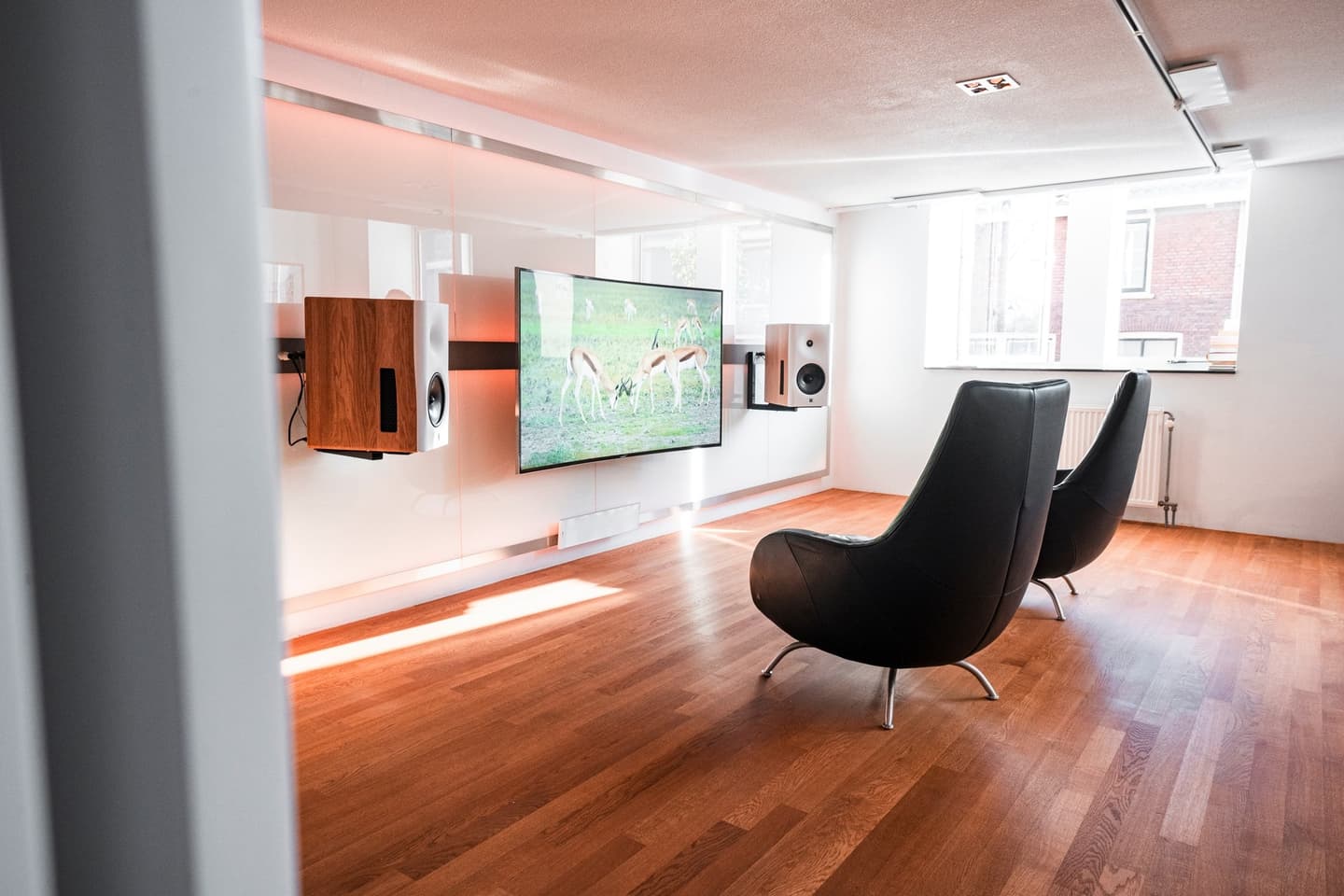
While room modes dominate the bass, reflections govern the midrange and treble. The most important reflections are the earliest ones - sound that bounces off the nearest surfaces (side walls, ceiling, floor) and arrives at your ears within about 20 milliseconds of the direct signal.
Your brain doesn't perceive these early reflections as separate echoes. Instead, it fuses them with the direct sound, and the tonal balance and spatial image shift as a result. A strong early reflection from a side wall can smear stereo imaging by sending sound from the left speaker to your right ear. Reflections from a hard ceiling can cause comb-filtering - a series of peaks and dips created when the direct and reflected signals interfere with each other.
Reverberation time, or RT60, is the standard metric for how long sound lingers in a room. It measures the time it takes for a sound to decay by 60 decibels - roughly from a loud clap to silence. A large concert hall might have an RT60 of 2 seconds or more, which gives orchestral music a warm, enveloping quality. A recording studio control room, by contrast, might target 0.3 to 0.4 seconds to maximize clarity and precision.
For home listening, an RT60 of 0.3 to 0.6 seconds is generally considered ideal, depending on room size and personal preference. Too short and the room feels dead and lifeless; too long and detail is lost in a wash of reflections. RT60 is proportional to room volume and inversely proportional to the total absorption in the room - add soft furnishings, curtains, or dedicated acoustic panels, and the reverberation time drops.
“The room is the final link in the audio chain, and it is by far the most significant. The difference between a poor room and a well-designed room dwarfs the difference between a good amplifier and a great one.”
- Floyd Toole, Sound Reproduction: The Acoustics and Psychoacoustics of Loudspeakers and Rooms
Every surface in your room interacts with sound differently, and the interaction depends on frequency. Hard, flat surfaces like glass windows, concrete walls, and hardwood floors reflect most of the energy that hits them, especially at mid and high frequencies. Soft, porous materials like thick curtains, upholstered sofas, and bookshelves filled with books absorb high-frequency energy while letting bass pass through largely unaffected.
When loudspeaker reviewers measure a speaker in an anechoic chamber (a room designed to absorb all reflections), they capture its true, inherent character. But nobody listens in an anechoic chamber. In a real room, the speaker's off-axis radiation interacts with every surface, and the total sound at the listening position is a blend of direct and reflected energy shaped by the room's unique geometry, dimensions, and materials.
This is why a speaker that sounds perfectly balanced in a showroom can sound bass-heavy in your living room or thin in a friend's apartment. The speaker hasn't changed - the acoustic environment has. Room modes may boost certain bass frequencies by 10 dB or more while cutting others by the same amount. Reflections may alter the perceived tonal balance and stereo image. Even the speaker's position relative to walls and corners changes its low-frequency output dramatically.
Before reaching for acoustic panels or DSP correction, start with placement. Moving speakers away from corners reduces boundary-reinforced bass. Adjusting the distance from the rear wall controls the balance between low-frequency modes. Ensuring your listening position isn't at a room node (typically dead center or right against the back wall) avoids the worst bass nulls. These adjustments cost nothing and can be transformative.
Understanding your room's acoustic behavior is the foundation for everything else - treatment, speaker placement, and digital correction all build on this knowledge. The most effective approach is layered: start with speaker positioning, address the worst reflection and absorption problems with treatment or furnishing choices, and then apply DSP-based correction to handle what remains, particularly in the bass.
At Callens Audio Labs, every setup begins with the room. When we install and calibrate a system, we evaluate the space, measure its response, and work with you to find the placement and configuration that gets the most out of your investment. Because no matter how good the speakers are, the room always has the final word.