Room Acoustics 101: How Your Room Shapes What You Hear
Your room is arguably the most important component in your audio system. Understanding how sound behaves in enclosed spaces is the first step toward better listening.

Callens Audio Labs
Ask me anything
Hi! How can I help?
Ask about our speakers, services, demos, or anything else.
Powered by AI · May make mistakes · Paul is always available
DSP-based room correction promises to fix your room's acoustic problems at the push of a button. Here's what it really does, how it works, and where its limits lie.

Every room changes the sound of your speakers. Bass frequencies pile up at certain points and vanish at others. Reflections alter tonal balance and blur imaging. The frequency response you paid for in the loudspeaker is not the frequency response you hear at your listening position. Digital room correction (DRC) aims to close that gap - and when applied thoughtfully, it can be remarkably effective. But it is not magic, and knowing how it works helps you use it well.
Room correction begins with measurement. A calibrated microphone - typically an omnidirectional measurement mic like the MiniDSP UMIK-1 or an Earthworks M30 - is placed at the listening position. The system plays a test signal through the speakers, most commonly a logarithmic sine sweep that moves from 20 Hz up to 20 kHz over several seconds. The microphone captures how the room and speakers together respond to that signal.
What you're really capturing is the room's impulse response: a complete fingerprint of how sound travels from the speaker to the microphone, including every reflection, resonance, and absorption along the way. From this single measurement, you can derive the frequency response (which frequencies are louder or quieter than they should be), the phase response (whether different frequencies arrive at the correct time relative to each other), and the decay characteristics (how long different frequencies linger in the room).
Most modern correction systems take measurements at several positions around the listening area - not just the exact sweet spot. This is critical because room modes create wildly different frequency responses at points only centimeters apart. By averaging or spatially weighting multiple measurements, the system avoids over-correcting for a single point, which would make the response worse everywhere else.
The most immediately audible effect of room correction is frequency response equalization. The system compares the measured response at the listening position to a target curve - ideally a gently downward-sloping response that matches how we naturally perceive balanced sound in rooms - and designs filters to compensate for the difference.
If the room has a 12 dB peak at 63 Hz caused by a room mode, the correction filter applies a corresponding cut at that frequency. If there's a broad dip in the midrange caused by destructive interference, the system applies a boost. The goal is not a ruler-flat response (which would sound unnatural in a real room) but a smooth, controlled curve free of the sharp peaks and dips caused by room interactions.
Under the hood, room correction systems use two fundamentally different types of digital filters, each with distinct strengths.
IIR filters are the digital equivalent of traditional analog EQ. They use feedback - each output sample depends on previous output samples as well as the input. This makes them computationally efficient: you can implement a precise parametric EQ band with just a handful of coefficients. The trade-off is that IIR filters introduce phase shifts. When you cut a bass peak with an IIR filter, the amplitude is corrected, but the phase response is altered in a way that's tied to the filter shape. Systems like basic parametric EQs and many hardware processors use IIR filters.
FIR filters work differently. They have no feedback - each output sample depends only on the current and past input samples. This gives them a crucial advantage: they can correct both amplitude and phase independently, without one affecting the other. A well-designed FIR correction filter can flatten the frequency response and align the arrival time of different frequencies simultaneously. The cost is computational: a high-resolution FIR filter for bass correction might require thousands of taps (coefficients), demanding significant processing power.
Frequency-domain correction asks: "Is each frequency at the right level?" Time-domain correction asks a deeper question: "Does each frequency arrive at the right time?" A room mode doesn't just make a bass note louder - it also makes it ring longer, smearing the transient and muddying the sound. A purely frequency-domain correction (like basic parametric EQ) can reduce the peak's amplitude, but it won't stop the ringing.
Time-domain correction, typically achieved with FIR filters, addresses both. By shaping the filter's impulse response to counteract the room's excess energy over time, it can tighten bass transients and reduce the audible decay of room modes. This is where sophisticated systems like Dirac Live and Dutch & Dutch's RoomMatching diverge from simpler parametric EQ approaches.
This is where honest conversation matters, because room correction has real and fundamental limitations.
“Room correction software cannot fix a room's reverb problem. There are two behavioral zones inside a room: bass resonances, and everything above them. Digital EQ works in the first zone. The second zone needs acoustic treatment.”
- John Darko, Darko.Audio
REW is a free, open-source measurement tool that has become the standard for room analysis. It captures detailed frequency and impulse response measurements, displays waterfall plots showing how energy decays over time at each frequency, and can generate parametric EQ filters for hardware that supports them. REW is a measurement and analysis tool rather than an automatic correction system - it gives you the data, but you decide what to do with it. This makes it extremely powerful in knowledgeable hands and the go-to tool for anyone serious about room acoustics.
Dirac Live is a fully automated room correction system available in select processors and streamers. It takes multiple measurements around the listening area, generates mixed-phase correction filters that address both frequency and time-domain issues, and offers selectable target curves including the Harman curve. Dirac handles the entire process from measurement to filter generation to application, making it accessible to non-technical users while still delivering sophisticated correction.
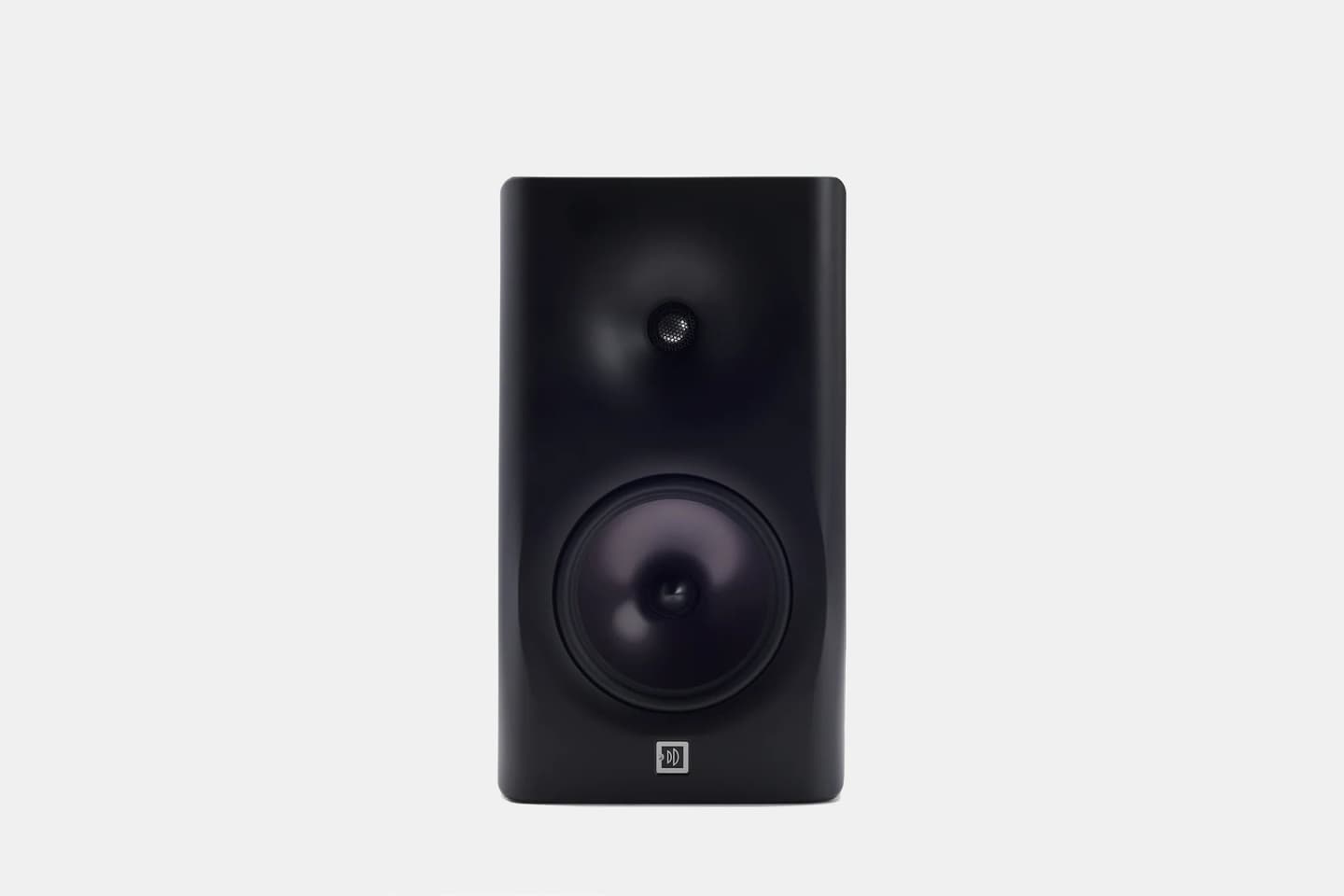
RoomMatching takes a fundamentally different philosophical approach. Rather than relying primarily on DSP to fix acoustic problems after the fact, Dutch & Dutch designed the 8c speaker to minimize those problems acoustically in the first place.
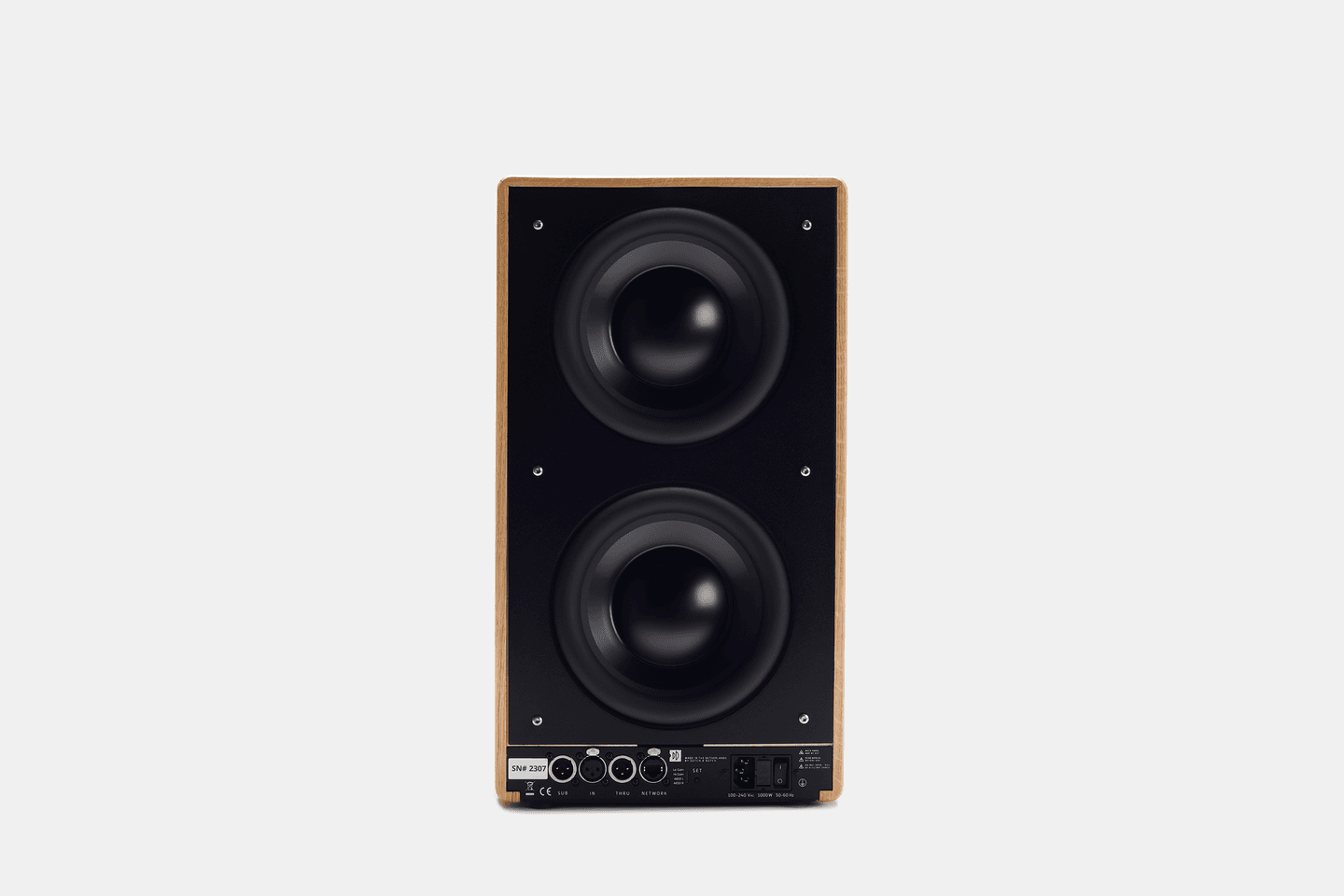
The 8c uses a cardioid radiation pattern in the midrange, meaning it radiates significantly less energy toward the wall behind it compared to a conventional speaker. Its constant-directivity waveguide ensures the high-frequency coverage is smooth and predictable off-axis. And its boundary-coupled bass loading is designed to work with the rear wall rather than fighting it, allowing placement just 10 to 50 centimeters from the wall without the bass bloat that would cripple a conventional speaker in the same position.
On top of this acoustic foundation, the 8c integrates REW-based room EQ that targets the low-frequency range where DSP is most effective. You measure with REW, the system generates correction filters tailored to your room's specific modal behavior, and the result is applied inside the speaker's onboard DSP. It's acoustic design first, digital correction second - applied only where it actually works.
The most important takeaway is this: room correction is not a substitute for good acoustics. It is a complement to them. The most effective systems - and the best-sounding rooms - combine thoughtful physical treatment with targeted digital correction.
Room correction technology has matured enormously. Modern systems can measure, analyze, and correct room interactions with a precision that was unthinkable a decade ago. But the physics hasn't changed: sound still bounces off walls, builds up in corners, and cancels at nodes. The best results come from understanding both the capabilities and the limits of DSP, and from choosing equipment - like the Dutch & Dutch 8c - that minimizes acoustic problems by design rather than trying to fix them entirely in the digital domain.
At Callens Audio Labs, setup and calibration are part of what we do. Every 8c installation includes measurement, room analysis, and RoomMatching configuration tailored to your space. Because getting the acoustics right isn't an optional extra - it's the whole point.