Class D Amplifiers: The Technology Powering Modern Speakers
Class D amplifiers deliver enormous power with remarkable efficiency - and despite the name, they're not digital at all. Here's how this misunderstood technology works and why it's essential to modern active speaker design.
Paul Callens
Founder, Callens Audio Labs
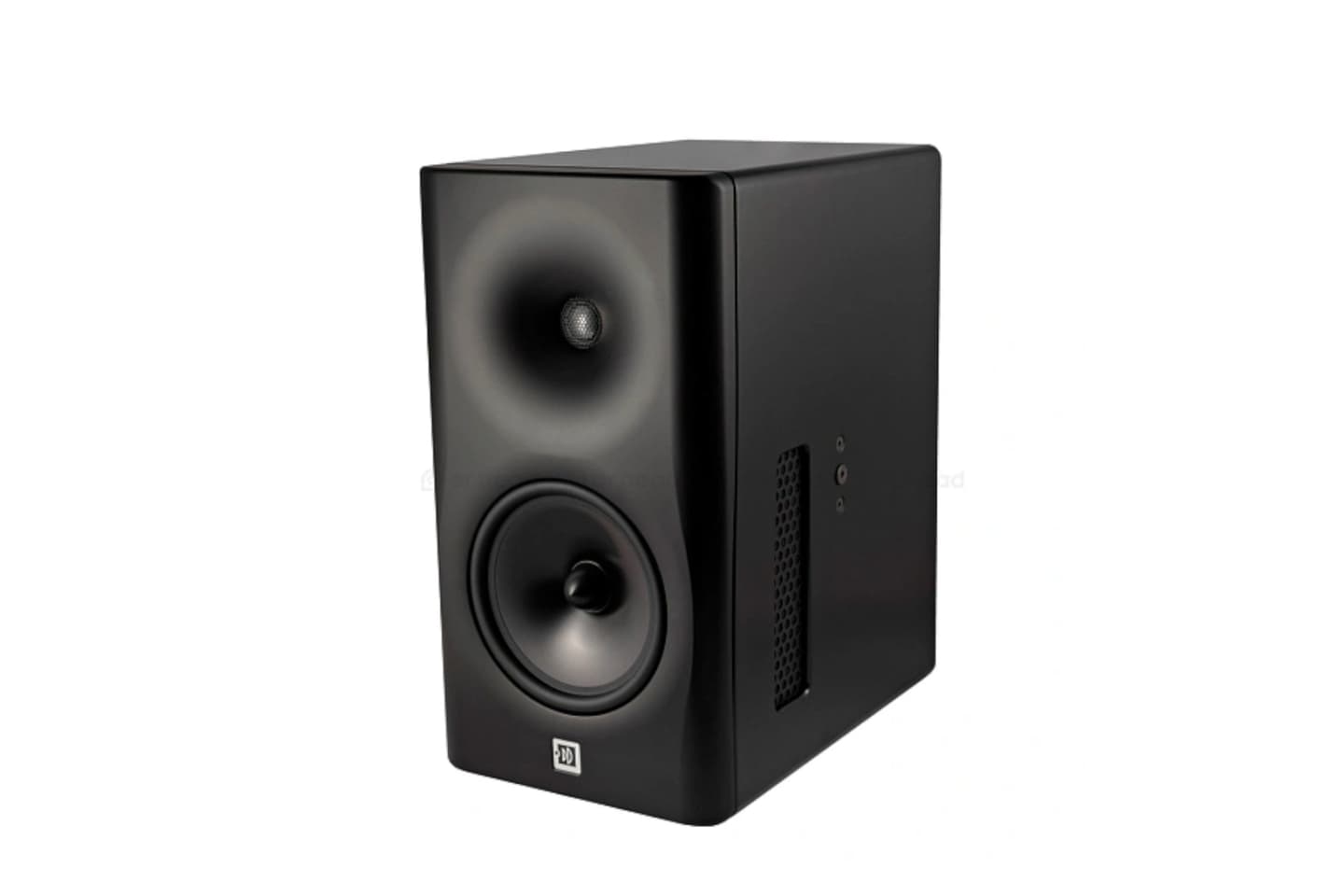
If you've looked into high-end active speakers, you've encountered the term "Class D" amplification. It powers everything from compact Bluetooth speakers to serious studio monitors, and it's the technology inside the Dutch & Dutch 8c that delivers 1000 watts of total amplification in an enclosure that stays remarkably cool. Yet Class D remains one of the most misunderstood technologies in audio. Let's set the record straight.
First, What Class D Is Not
The single biggest misconception about Class D amplifiers is right there in the name. The "D" does not stand for "digital." Class D amplifiers are fundamentally analog devices. The letter simply follows the naming convention used for amplifier topologies - Class A, Class B, Class AB, and then Class D. There is no Class C in audio (it's used in radio-frequency applications).
This distinction matters because it shapes expectations. A Class D amplifier doesn't digitize your music, doesn't introduce quantization artifacts, and doesn't require digital-to-analog conversion at its output. The input is analog, the output is analog, and the amplification process - while it uses a switching technique - operates entirely in the analog domain.
Despite its name, a Class D amplifier contains no analog-to-digital or digital-to-analog converters. The signal path is entirely analog - the 'D' is just the next letter in the amplifier classification system after A, B, and AB.
How Class D Amplification Actually Works
To understand Class D, it helps to first understand what conventional amplifiers do. In a Class A or Class AB amplifier, the output transistors operate as variable resistors, continuously conducting current and modulating voltage to create an amplified version of the input signal. This works, but it means the transistors are always partly "on," dissipating unused energy as heat. A Class A amplifier wastes roughly 75% of its power as heat; Class AB improves this to around 40% waste, but that's still substantial.
Class D takes a radically different approach. Instead of using transistors as variable resistors, it uses them as switches - rapidly toggling between fully on and fully off. When a transistor is fully on, it has near-zero resistance and dissipates almost no power. When it's fully off, no current flows. In either state, very little energy is wasted as heat.
The Pulse-Width Modulation Process
The core of a Class D amplifier is a modulator that converts the incoming audio signal into a pulse-width modulated (PWM) waveform. Here's how it works, step by step.
A high-frequency triangle or sawtooth wave (typically 250 kHz to 1.5 MHz) is generated internally as a reference signal.
The incoming audio signal is compared against this reference. When the audio signal's voltage is higher than the reference, the output switches on; when it's lower, the output switches off.
This produces a stream of pulses whose widths (durations) are proportional to the audio signal's amplitude at each instant. A loud passage creates wider pulses; a quiet passage creates narrower ones.
The high-power switching stage - typically MOSFET transistors - amplifies these pulses to speaker-driving voltage and current levels.
A low-pass output filter (usually an inductor-capacitor network) removes the ultrasonic switching frequency and reconstructs the smooth, amplified analog audio signal that drives the speaker.
The entire process is analog. The audio signal is never sampled or quantized - it's continuously compared against the reference waveform. The pulse widths carry the audio information in an analog-encoded form, and the output filter recovers it faithfully.
The Efficiency Advantage
The practical impact of Class D's switching topology is dramatic. Where a Class AB amplifier converts roughly 50-65% of its electrical input into audio output (the rest becomes heat), a well-designed Class D amplifier achieves 85-95% efficiency. For a 500-watt amplifier, this is the difference between generating 250 watts of waste heat versus 50 watts.
This efficiency advantage has several cascading benefits that go well beyond the electricity bill.
Dramatically less heat generation, reducing or eliminating the need for large heatsinks and cooling fans
Smaller, lighter power supplies and output stages for the same power output
Higher power density - more watts in less physical space
Greater long-term reliability, since heat is the primary enemy of electronic components
Feasibility of placing multiple high-power amplifiers inside a speaker enclosure without overheating
That last point is crucial. Without Class D, the modern active speaker as we know it wouldn't be practical. Imagine trying to fit three Class AB amplifiers totaling 1000 watts inside a loudspeaker enclosure - the heat alone would require an industrial cooling solution and would likely affect the speaker's acoustic performance.
Class D and the Rise of Active Speakers
The active speaker concept - where each driver gets its own dedicated amplifier - has been technically sound since the 1970s. But early active speakers relied on Class AB amplification, which meant bulky, hot enclosures with limited power. Class D changed the equation entirely.
With Class D modules that deliver hundreds of watts from a circuit board smaller than a playing card, speaker designers gained the freedom to put serious amplification inside the cabinet without thermal or space constraints. This enabled multi-amplified designs where a woofer, midrange driver, and tweeter each receive individually optimized power - the kind of configuration that extracts the maximum performance from every driver.
Class D efficiency allows the 8c to house 1000 watts of amplification without external cooling - essential for studio environments where fan noise would be unacceptable.
Dispelling the Remaining Myths
"Class D sounds harsh or thin"
Early Class D amplifiers from the 1990s and early 2000s did have audible limitations, particularly in high-frequency reproduction and transient response. These issues stemmed from relatively crude switching topologies and output filter designs, not from any inherent flaw in the principle. Modern Class D amplifiers using advanced MOSFET switching, sophisticated feedback networks, and optimized output filters are sonically indistinguishable from the best Class AB designs in controlled listening tests. Many golden-eared reviewers and mastering engineers now use Class D-powered monitors as their primary reference.
The high-frequency switching in Class D amplifiers can generate electromagnetic interference (EMI) if the design is poorly implemented. However, reputable manufacturers use careful PCB layout, proper shielding, and spread-spectrum modulation techniques to keep EMI well within regulatory limits. In a well-engineered active speaker where the amplifier and drivers are designed as an integrated system, EMI is a non-issue.
"You need Class A or AB for serious listening"
This was a defensible position fifteen years ago. Today, Class D amplification has matured to the point where some of the most respected loudspeakers in the world - from Kii Audio's Three to Genelec's "The Ones" series to the Dutch & Dutch 8c - rely exclusively on Class D power. The technology hasn't just caught up; in the context of active speaker design, it has become the preferred approach because of the design freedoms it enables.
“The 8c is an exceptional speaker, an exceptional value.”
- The Absolute Sound, 2025 Integrated System of the Year
Inside the Dutch & Dutch 8c: Class D in Practice
The Dutch & Dutch 8c provides a real-world case study in how Class D amplification enables sophisticated speaker design. Each 8c contains three Class D amplifier channels with power factor correction and hybrid cooling.
500W for the low-frequency section (two 8-inch aluminum-cone woofers in a sealed, cardioid configuration)
250W for the midrange (one 8-inch aluminum-cone driver with acoustic cardioid dispersion)
250W for the high-frequency section (one 1-inch aluminum/magnesium alloy dome tweeter)
That's 1000 watts of total amplification in an enclosure measuring just 485 × 270 × 380 mm. The speakers achieve a maximum linear SPL of 106 dB continuous from 35 Hz - performance that rivals large floorstanding speakers - while running cool enough to sit in a sealed studio without any fan noise. This simply wouldn't be achievable with Class AB amplification.
The efficiency of Class D also means the power supply can be smaller and lighter, which is why each 8c weighs a (relatively) manageable 26 kg despite containing a complete three-way amplification system plus DSP processing. Power factor correction ensures the amplifiers draw current efficiently from the mains, reducing the demands on your electrical circuit even at high output levels.
Power factor correction (PFC) is a circuit that ensures the amplifier draws current from the mains in phase with the voltage, reducing wasted reactive power. Combined with Class D efficiency, it means the 8c draws surprisingly little power for its output capability.
What This Means for Listeners
For anyone assembling a high-performance audio system, Class D amplification in active speakers offers a compelling combination: reference-grade power, minimal heat and energy waste, compact form factors, and the design freedom for speaker engineers to optimize every aspect of the system as an integrated whole.
The days of needing a massive power amplifier, heavy speaker cables, and a well-ventilated equipment rack to achieve top-tier sound are behind us. A pair of Dutch & Dutch 8c speakers, connected to a source via Ethernet or AES3, delivers world-class sound from two elegant enclosures - and Class D is the technology that makes it possible.
At Callens Audio Labs, I help clients in the Lausanne area experience this technology firsthand. Whether you're building a dedicated listening room, a home studio, or simply want the best sound quality your space allows, I'd welcome the chance to demonstrate what modern Class D-powered active speakers can do. The engineering speaks for itself - but hearing it is another thing entirely.
Related articles
Ready to hear the difference?
Get in touch and experience what you've been reading about.
class Damplificationefficiencyactive speakerstechnology